The life and legacy of the College’s beloved goose, Jorge

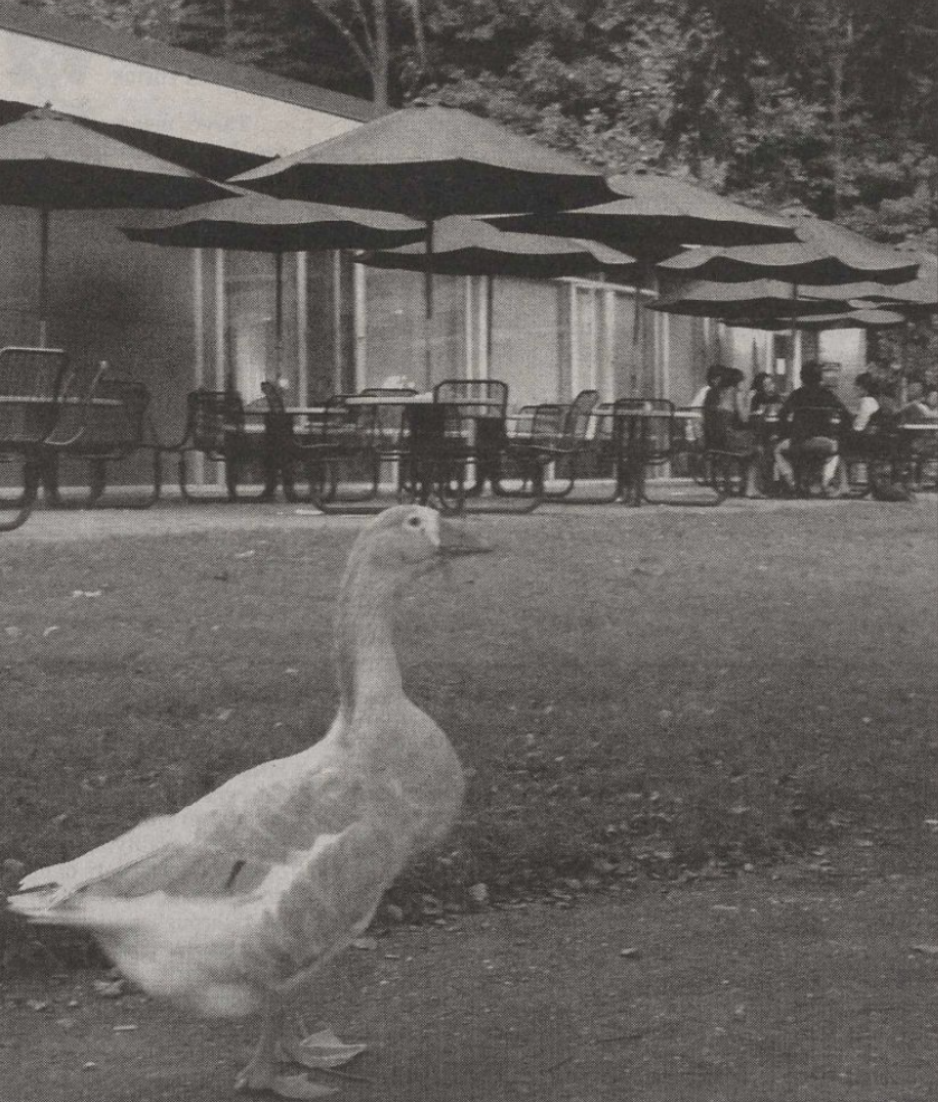
Photo by Caitlin Healey ’09

This is the first known photograph of Jorge the goose to have been printed in Mount Holyoke News.

By Madeleine Diesl ’28

Science & Environment Editor

On Dec. 9, 2024, tragedy struck Mount Holyoke College: Jorge, the campus goose, flew into a Blanchard Hall window and died. Jorge was a feral Pilgrim goose who frequented Lower Lake, but his legacy was much more than that: He was the unofficial mascot of LITS and a large part of the student culture at Mount Holyoke for several decades. Now, a year after this dreadful event, we can remember Jorge by his many appearances in the College’s digital archives, particularly in past Mount Holyoke News articles.

In the Nov. 11, 2004 issue of MHN, Rachael Robins ’07 claimed that they liked to “feed the goose granola from [their] own mouth,” perhaps referring to Jorge. A year later, in the Sept. 29, 2005 issue, Katie Adler ’08 wrote an article detailing a day in the life of the “Mangled Goose,” which is described as having a “strong and thick orange beak” and “[lurking] along the shoreline near Prospect [Hall], stalking its next victim.” Though he remains unnamed, it can only be assumed that Adler is describing Jorge. 

One of the first references to Jorge by his name, “Jorge,” appears to be in the 2007 April Fool's issue, in a joke article by “Anonymous Samanta ’10” about him relocating from Lower Lake to Wilder Hall. However, the writer also refers to him as “Hubert,” a name that never shows up elsewhere in the digital archives. In fact, over the course of the past 20 years, Jorge has been called “Hubert,” the “Mangled Goose,” the “Prospect Goose,” the “Lower Lake Goose,” and even the “Big White Ugly” in a photo caption in the Sept. 18, 2008 issue. This photo, which depicts Jorge walking next to an outdoor dining area, is actually the earliest known photograph of Jorge in an MHN article. 

Current students have a lot to say about Jorge, as well. When asked about his death, Yan Hernandez ’28 said, “Jorge has left an intersex grey pilgrim goose shaped hole in my heart. I miss seeing him lord over Lower Lake and eating bugs in the grass. He was truly the best of us. #Latinopride.” 

Amy Gingras ’28 referenced the fictional character Eggman from one of SnapCube’s Sonic the Hedgehog fan dubs on YouTube:  “I miss my goose. I miss him a lot. I’ll be back.” 

Missing Jorge’s presence has been a common theme amongst students, as Nicole Lasko ’28 commented: “He was well loved and he is universally missed … there's never going to be another like him.”

If you’re interested in learning more about Jorge and Mount Holyoke News’s history in general, pay a visit to the Five College digital archives website or Mount Holyoke’s Archives and Special Collections and search for the Mount Holyoke College student newspaper collection – the yearly April 1st articles are particularly entertaining!

Quill Nishi-Leonard ’27 contributed fact-checking.

Dr. Ojeda Linares discusses ethnomicrobiology in Nov. 11 lecture

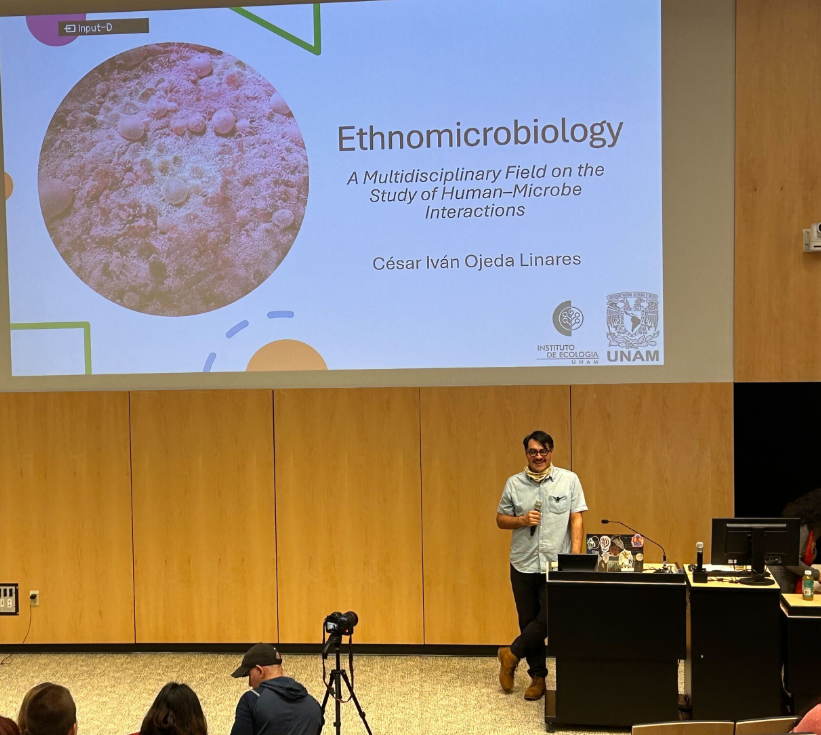
Photo by Angelina Godinez ‘28

Dr. Ojeda Linares traveled to Mount Holyoke College to deliver a guest lecture on ethnomicrobiology in Gamble Auditorium.

BY ANGELINA GODINEZ ‘28

MANAGING EDITOR OF SOCIAL MEDIA

On Nov. 11, Mount Holyoke College’s Department of Critical Race and Political Economy hosted ethnographic microbiologist Dr. César Iván Ojeda Linares to deliver a unique lecture on ethnomicrobiology and cultural preservation of traditional and indigenous fermentation practices. Ojeda Linares is a recent Ph.D. graduate from the National Autonomous University of Mexico who promotes traditional fermentation techniques throughout Mexico through a mix of ethnography and microbiology. 

The lecture began with Visiting Professor of Critical Race and Political Economy, Pilar Egüez Guevara, introducing Ojeda Linares and discussing how this lecture connects to her course, Latinx Foodways, where students are encouraged to think of cultural food production and consumption. Through Ojeda Linares’ ethnographic work and effort to preserve cultural practices from big pharmaceutical companies, students get to learn the cultural consequences of micropiracy and the capitalization of traditional fermented drinks such as kombucha and colonche. 

Fermentation is a natural process which uses microorganisms to produce a variety of foods and beverages. Microorganisms are organisms often composed of just one cell, typically too small to be seen under a microscope; these seemingly invisible organisms shape the planet's atmosphere and are a companion to all human evolution. They exist everywhere — in water, soil, air, on our skins, in the food we eat and can either have a positive or negative effect on the human body. Ethnomicrobiology aims to understand and reflect on the historical and dynamic human knowledge systems about microorganisms. Like most scientific research, research on microbes — and therefore fermentation — often remains completely disconnected from traditional ecological practices in Indigenous traditions. 

Ojeda Linares sought to correct this lack of traditional scientific knowledge, starting with learning about the fermentation process of colonche, a fermented drink made from the prickly pears found on cacti. Colonche has historical origins in Zacatecas and Guanajuato, Mexico and is well known for its vibrant color and similarities to tapeche and pulque. In Ojeda Linares’ study, he discovered the importance of using traditional clay pots during the fermentation process in order to best maintain microbial communities, further emphasizing the importance of traditional fermentation practices as opposed to modern techniques involving stainless steel and fabricated starter cultures. 

To underline the  significance and importance of traditional fermentation practices, Ojeda Linares shared results from an experiment where selected participants consumed a liter of colonche a month and experienced changes such as increased sleep, libido and overall health. When the same participants were offered a pill form of healthy microbes found in colonche, the results were not as significant. Ojeda Linares hopes to continue to bring information about microbes to young children and aid them in seeing their cultural practices in a positive light, motivating future generations to study ethnomicrobiology. 

Eden Copeland ’27 contributed fact checking. 

Caring for first-year plants: Advice from the Greenhouse

Graphic by Mari Al Tayb ’26

By Angel Fox FP’26

S&E Section Editor

Mount Holyoke College welcomed the class of 2029 during this past orientation, where they were able to receive their first-year plants from Talcott Greenhouse. Plants for incoming first-years carry on a tradition started in 1971 by then-greenhouse manager Johnny Walker, who wanted to connect students with the greenhouse and botanic garden from the moment they entered Mount Holyoke College.

Tom Clark, director of the Botanic Garden, explained, “The goal of the new-student plant project is to showcase the richness of the greenhouse as a resource for students. We also want to bring a little green into their lives during this period of intense transition.”

Caring for these plants may come as a challenge for first-time plant parents and busy college students, but solutions are available. Any students wondering how to care for plants can ask employees at the Talcott Greenhouse during open hours. There is also a plant table available, where students can re-pot plants that need new homes with the aid of greenhouse staff.

Potted plants need a few basics to survive: Appropriate temperatures, a certain amount of light and water (each depending on their type).

Step one of caring for a new plant is to identify the plant. Once the plant name is known, many different resources are available online and at the College’s greenhouse.

According to Alison Costello, Mount Holyoke’s horticulturist and botanic gardens expert, the first year plants included “The spider plant, Chlorophytum comosum, which may be solid green or variegated [multiple colors on its leaves] with lengthwise stripes of white or yellow; Swedish ivy, Plectranthus australis, with glossy green leaves, reddish stems and scalloped edges; variegated Swedish ivy, Plectranthus coleoides, [which has] lime green foliage with bright cream and a fuzzy leaf; and the inch plant, Tradescantia zebrina, purple and silver green creeping plants that are fast-growing and have trailing stems.”

Proper placement in dorms can be challenging, as many plants require a certain amount of light per day. As Mount Holyoke College sits in the Northern Hemisphere, south-facing windows get the most sun due to the earth's axial tilt. According to Costello, all the plants given out by the greenhouse are chosen for success, and they appreciate bright indirect light. For dorms that face busy walkways, window privacy film may assist in keeping curtains open so that plants can get sun.

Plants should not be placed too close to heaters or drafty cold areas. Most indoor plants should be in environments kept above 60 degrees. 55 degrees is too cold for the plants given out by the greenhouse. If plants need to be moved between buildings in winter, it is important to protect them from freezing temperatures with paper or plastic coverings. Indoor plants should not be stored in vehicles or other outdoor areas during the winter.

Watering new plants can be made easier by tracking time between waterings in a calendar or with reminders on phones. Time between waterings will vary depending on pot size and material. To check if your plant needs water, insert your finger about two inches into the soil near the edge of the pot. If your fingertip is dry, it needs water.

Every plant is different, but most potted plants do not want soggy or dried out roots. Always check soil before watering to prevent overwatering. Costello recommends avoiding killing the plant with kindness. Frequently, new plant owners will think a distressed or yellowing plant needs water; in fact, a plant with yellowing leaves has often already been overwatered. Overwatering a plant can lead to root rot. This causes the plant to become unable to take up water or nutrients, leaf-wilt, and eventual death.

Alternatively, when plants have been dry for too long, it is important to give them plenty of water. This can be tricky, as completely dry soil often separates from the edges of pot walls and prevents water from being fully absorbed by the soil and roots. Plants can be stressed during this period, so try to avoid creating soggy soil. Putting the plant in the sink under a gentle stream of water for a few minutes helps to ensure the soil has absorbed the water. Drainage holes in pots are necessary, as they allow the plant to release excess water. After the soil has sat under the tap for a few minutes be sure to check the soil to see if it is wet, not soggy, by scratching away a small section about an inch deep. If it is still dry, continue the gentle watering under the tap and check again in a few minutes.

If there are questions, or if any student’s plants are in distress, they can contact the Botanic Garden and greenhouse staff. Costello explains, “Use the Botanic Garden staff as a resource. We are here to help. The best way is to set up an appointment with us. Inside the greenhouse's main entrance is a poster with a QR code. You can use that code to schedule an appointment. We can help you with any questions you have, troubleshooting plant problems or transplanting your plant. If it's too cold for your plant to travel outside, take a picture — we will try to give you tips from there. Soil and pots are also provided for students if they want to do it themselves. [These are] available anytime we are open: Monday-Friday 9-4, or Saturday and Sunday 1-4.”

There are many unique plants on display both in the greenhouse and Botanic Garden. Costello also urges students to take advantage of the garden’s many benches to destress or get some work done. Accessing the gardens and greenhouse is easiest from the Upper Lake entrance or from the stairs near Clapp Laboratory due to the ongoing geothermal project. Additionally, there will be many events in the Botanic Garden and greenhouse this fall.

Costello states, “Coming up this fall, the Botanic Garden will be hosting tours during Family and Friends Weekend. One tour available will be on that Sunday, focusing on the outdoor plants within the botanic garden, and the pollinators and animal habitats it supports. Check out the schedule when it becomes available and sign up to join us!”

Karishma Ramkarran ’27 and Madeleine Diesl ’28 provided fact-checking.

Updates on the College's Geothermal Project in summer 2025

Photo by Paige Comeau ’26
A view of the geothermal project work near the Ciruti Language Center and the Mail Center.

By Paige Comeau ’26

Managing Editor of Content

Over the summer break, students may have noticed various construction sites springing up across campus as Mount Holyoke College entered phase three of its ambitious geothermal energy project. As work on this project continues into the new academic year, it may be beneficial to review the progress made over the summer term.

Phase three began on March 17, 2025, with work along Lower Lake Road to install distribution piping. Construction occurred in segments, with the first starting at the end of Park Street and ending along the north end of Talcott Greenhouse. This work was completed in early May, before graduation, and continued throughout the rest of the summer in three other areas between the greenhouse and the Community Center. Construction along other areas of Lower Lake Road, between Torrey Hall and the Betty Shabazz Cultural Center, is scheduled to continue through early January.

Site preparation for work on the club rugby field began mid-May, with drilling beginning in June. The bores drilled into the field will eventually be turned into the thermal energy storage system that the geothermal project relies upon. The drilling is expected to last into October, during which access to the rugby field will be restricted. While a general restoration of the field is planned for late 2025 or early 2026, a full restoration is expected to take place in 2027. As of right now, the club rugby team is practicing on the Mosier Elementary School pitch on Mondays, Tuesdays, and Thursdays and on the field behind Creighton Hall on Wednesdays and Fridays. Rugby player Isabella Borrego ’27 encourages students interested in the sport to join the email list in case of any sudden changes.

Additional valve replacement work was spread throughout the summer months, with construction around Kendade Hall, Porter Hall, and Safford Hall being completed in August. Construction is scheduled to continue throughout the remainder of the fall semester, starting in mid-September near Skinner Green, to replace leaking gaskets on the hot water distribution lines of which will be finished by the end of October, but will remain restricted until mid-November. Similar work is also being done near Mary Wooley Circle during the same time frame.

Alongside this exterior work, four residence halls went under construction this summer: Mead Hall, Mandelle Hall, and both North and South Rockefeller Hall. Work on these four residences began in late May with updates to accessibility and infrastructure alongside conversions in the heating and cooling systems to allow for use of the geothermal energy. Some of the planned updates include a revamped Golden Pear, lounge space, and sprinkler system in Mead, window replacements in the Delles, as well as improvements to create more accessible dorm rooms, an accessible ramp, doors and patios in Rockefeller Hall.

While students are on campus, work in the basement and on the accessible ramp of Rockefeller Hall continues. Temporary laundry and trunk rooms are available on the first floor to accommodate the residents while certain areas remain inaccessible.

In Mead, construction is planned to restart during winter break, when the first floor commercial kitchen will be made into a new student lounge and the existing Golden Pear will be updated.

Students looking for more information on the geothermal project or ongoing construction can visit the Mount Holyoke College website, or go to an in-person “Thermal Thursdays” meeting on Sept. 25, held in room 118 of the Kohler Building from 9-10:30 p.m.

Karishma Ramkarran ’27 and Madeleine Diesl ’28 provided fact-checking.
Observatory Open House: Refracting space and time

Observatory Open House: Refracting space and time

After an eventful day of Family and Friends Weekend programming, students and their guests concluded the evening of Oct. 26 by enjoying a tradition of cosmic conversations and observations with astronomy faculty and students in Mount Holyoke College’s oldest continuously-used academic building, Williston Observatory. 


Weekly Cortex Café gathering fosters connections among students and faculty

Weekly Cortex Café gathering fosters connections among students and faculty


Every Tuesday from 4 to 5 p.m. in Clapp Laboratory’s Lewine Room, faculty members from the Neuroscience and Behavior department of Mount Holyoke College provide snacks and activities for students at the Cortex Café, a meeting for students interested in Neuroscience and Behavior to come together and casually chat about the field.


Updates on ongoing geothermal energy project

Updates on ongoing geothermal energy project

As the Mount Holyoke College campus has become populated with students arriving for the fall semester, some may have noticed the ongoing construction throughout the grounds. Places like Skinner Green, Mary Woolley Hall and the Reese Psychology and Education building continue to be renovated while students, staff and faculty live and work across campus.

Computational advances help with protein structure prediction

Computational advances help with protein structure prediction

Proteins are commonly associated with foods such as meats, lentils and eggs. While they are crucial for building muscles, they are also involved in numerous other life processes. Scientists are developing artificial intelligence models that are advancing the process of protein structure determination, making it faster and more accurate and opening up new possibilities for future study.