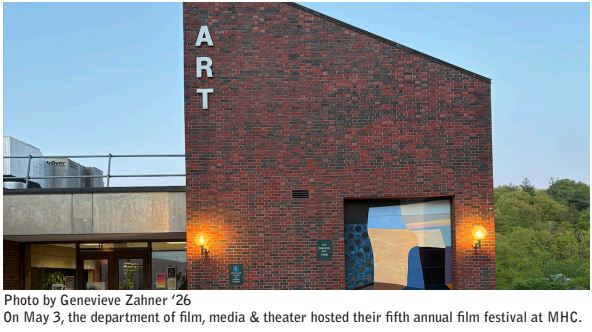
College department of film, media, theatre hosts fifth annual film festival

By Genevieve Zahner ’26

News Editor

On Sunday, May 3, the Mount Holyoke department of film, media, and theatre held their fifth annual film festival, showcasing student films. According to the program, the films were: 

“Women’s Room” by Ahava Arias ’28, Clara Canavan ’27, Danny Hernandez ’27, Cora Laroche ’26, Jasmine Thomas ’26, “Siempre Soñando” by Jasmine Garcia-De Los Santos ’27, “Lost in Time” by Hollie Cornish ’26, “A Yearning” by Charlie Penna ’27, “Out Loud” by Lily Ariel Mueller ’26, “Mind Loaded or, What I See When I Look at Cards” by Namuuna Negi ’27, “Exhibit S” by Sara Sabry ’28, “LE FALTON SAZON” by Tati Martinez Alvarez ’28, “Losing You” by Amaya Fernando ’28, “Dance Macabre” by Emma Pedroni-Meyer ’26, “Here, There, and Everywhere” by Vania Correia Almeida ’27, “Overthinking It” by Autumn Gebhardt ’26, “Cultural Survival Guide” by Jiayin “Winnie” Wu ’28, “Noise” by Emma Pedroni-Meyer ’26, and “Off Balance” by Hollie Cornish ’26, Autumn Gebhardt ’26, Cristina Lopez Mendoza ’27, Lily Ariel Mueller ’26, Gianna Scott ’26 and Jiayin “Winnie” Wu ’28.

Autumn Gebhardt ’26 and Ria Miller ’26 co-directed the film festival, and of the experience, Gebhardt said in an email to Mount Holyoke News, “Flonia [Telegrafi] recruited Ria and me as the co-directors for this year's festival back in the fall, and we were both super excited to do it.”

 “We've had meetings with Flonia all throughout this semester to check in on our progress and talk through the next steps. We've created and circulated publicity materials for the Call for Submissions and the festival itself (posters, trailers, announcements, etc.); collaborated with Amanda Dumais (FMT department coordinator) to put in the catering order, book the space and tech support, and other important tasks involving budgets and logistics; and put together the festival screener with the selected films,” Gebhardt wrote. The process was selective, with 15 films being screened out of 32 submissions. 

In addition to co-directing the festival, Gebhardt also acted in two short films and created their own film, “Overthinking It,” and co-created the film “Off Balance.” With acting, it all fell into place out of chance for Gebhardt, saying “I didn't really audition for either of the projects I acted in. Lily only received one audition for Out Loud, and they weren't going to be able to make the film if they couldn't find someone else to fill the other role, so I offered to do it.” 

As for “Losing You,” Gebhardt wrote, “I was initially just going to be on her crew, but I ended up acting because she wanted someone who could play guitar (and I fit the bill).” Additionally, “I was especially happy to get to collaborate with Amaya like that.”  

On the production process for the two films she created, Gebhardt said, “Overthinking It came together remarkably quickly, as I needed to get the whole thing shot very shortly after it was written and cast due to conflicts with my schedule later on in the month. I put out a call for self-tape auditions and received one from the incredibly talented Betty Liao ’27, and then I asked my good friend Lily Mueller ’26 (director of Out Loud) if they'd be willing to fill the other role.” 

The film was shot in just four hours, in order to fit the tight timeline. For “Off Balance,” Gebhardt said, “I directed one of the scenes, and I did sound for the rest. Sound is one of my favorite jobs to have on set, and it's easily my favorite part of editing as well. We were working with three channels of audio, including two lavalier mics that were worn by the actors, and the boom mic, which I was holding up for every take. I get really tuned into the way audio cuts together, and I have a lot of fun smoothing things out in the edit and bringing in additional sound to elevate the scenes. It's sort of my filmmaking niche when I'm not working on solo projects, and I was really happy to have an opportunity to be in my element for this project.”

Hollie Cornish ’26, an international student from Wales, worked on two projects for the film festival, her independent film “Lost in Time” and group project “Off Balance.” Cornish wrote bout the experience with “Off Balance,” in an email to Mount Holyoke News:, “We decided to combine 3 of our ideas into one to form what became ‘Off-Balance.’ My pitch was about an athlete who struggles with the fear of failure, and this was a part of the inspiration for this film. We also took concepts from 2 other pitches, including having the athlete begin to hallucinate in the form of notes being left in her locker. I was very enthusiastic about shooting a fight scene, so one of our focuses was on finding a way to build up to this point.” 

“I had the most fun coming up with unique shot ideas. I created a storyboard for the fight sequence after it had been choreographed (choreographed by Lex Canon – very talented!) to help figure out where to position the camera within this scene to keep the audience engaged.,” Cornish stated.

Speaking on the experience of working on “Lost in Time,” a film made for a 16 millimeter film class she took at the University of Massachusetts Amherst, Cornish said, “I came to Mount Holyoke as an international student from Wales, and I unexpectedly made a lot of international friends here, so I was inspired to create a film that incorporates a small selection of places that people are from on this campus. I wanted the film to touch on the passage of time and the importance of living in the moment. My time at Mount Holyoke passed a lot quicker than I expected and hoped for, and I’m sure many others can relate.” 16 millimeter film cameras were launched in 1923, therefore present a unique look and feel to films. Cornish mentioned that “Lost in Time” was an emotional experience to see it come together, as well as in post production. 

“This film isn’t like anything I’ve done before, so it was fun to experiment with and come up with ideas to incorporate a range of languages in a short amount of time.” She thanks Gebhardt and Miller for co-directing the film festival, as well as Professor Dien Vo, whose class several of the films came from. Gebhardt encourages students to lookout for information regarding next year’s festival, and that “Submitting and having your work screened is such a great experience to have, and I would encourage everyone who will be working on films in the coming year to give it a go!” Cornish stated.

Quill Nishi-Leonard ’27 contributed fact-checking.

Smith College under investigation by the Department of Education

By Bei Jia Viggiano ’28

Sports Editor

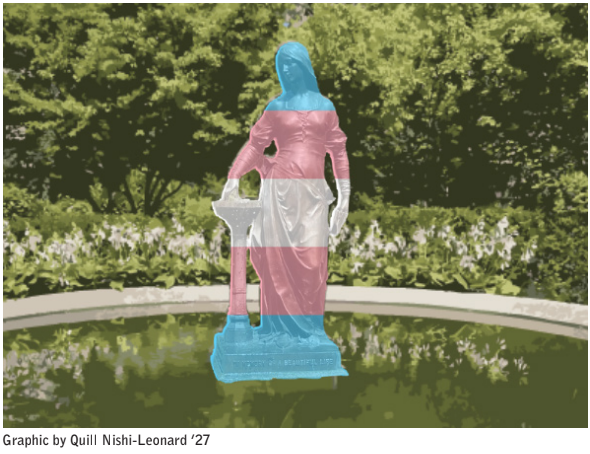
As of Friday, May 8, Smith College is under investigation by the U.S. Department of Education for its admission of transgender students. The Department claims that the College is violating anti-discrimination laws under Title IX; Assistant Secretary for Civil Rights at the Department of Education Kimberly Richey stated, “An all-women’s college loses all meaning if it is admitting biological males,” adding, “The Trump administration will continue to uphold the law and fight to restore common sense.”

Smith addressed the investigation in a statement that affirmed that the College will maintain their institutional values, which include compliance with civil rights laws. As of May 8, Smith’s president has not publicly spoken on the matter.

In a May 8 Dean’s Corner email to Mount Holyoke students, Dean Marcella Runell addressed the investigation: “I want you to know that Mount Holyoke is not currently under investigation, and I know that news like this can bring up a range of emotions.”

Runell closed by highlighting some support resources available to Mount Holyoke students, such as the College’s counseling service — which is currently operating on open-access scheduling until tomorrow, May 12 — and the 24/7 crisis line, which can be reached at 413-538-2037.

“Smith’s lack of empathy and action on behalf of its students is not an isolated issue,” a Smith student, who requested to remain anonymous, wrote to Mount Holyoke News. “It reflects a broader pattern of institutional silence and avoidance when it comes to protecting trans students. President Sarah [Willie-LeBreton]’s refusal to comment is not neutral, and in moments like this, her silence reads as complicity. Students are paying attention, and the absence of clear leadership in a moment that directly affects their safety and belonging is unacceptable.”

“The Department of Education’s investigation is unacceptable in both its premise and its impact,” the Smith student continued. “Under the current administration, its actions are not neutral; they actively create harm, fear, and uncertainty for trans students. It sends a message that their presence is something to be scrutinized rather than respected.”

An anonymous Smith alum from the class of 2025 voiced similar thoughts in an interview with Mount Holyoke News, “These threats from the DOE are yet another instance of the Trump administration attempting to rid our country of critical thinking and quality education, particularly among minorities. An educated people is a powerful people.”

“The Trump administration targets educated trans people, women and other gender minorities because it fears them,” the alum added.

Former Mount Holyoke College President Lynn Pasquerella contributed to the revision of Mount Holyoke College’s admission policies in 2014, allowing for the admittance of transgender students. She told The New York Times that Smith’s investigation “will create uncertainty for transgender students and discourage them from applying.”

“That will be the real loss,” Pasquerella stated.

“Institutions like Smith have a responsibility to push back clearly and publicly against actions that endanger their students, not to respond with vague or incomplete statements,” the Smith student added. “As a historically women’s college, Smith would not be what it is today without the presence, contributions, and leadership of [transgender] women. [Transgender] students are not an exception to this community — they are central to it. Their experiences, voices, and achievements shape this institution every single year.”

“I hope Smith College fights back and works diligently to protect its students physically, politically and academically, and lives up to its motto of ‘audacity, agency, authenticity,’” the Smith alum stated.

“At a minimum, students deserve transparency, accountability, and an administration that is willing to stand behind them without hesitation,” the Smith student concluded. “Silence in the face of harm is not neutrality; it is a choice.”

Paige Comeau ’26, Quill Nishi-Leonard ’27 and Madeleine Diesl ’28 assisted with coverage. Quill Nishi-Leonard ’27 contributed fact-checking.

Hampshire College announces definitive closure at the end of 2026

By Bei Jia Viggiano ’28

Sports Editor

Hampshire College announced on Tuesday, April 14, that the institution will close after their 2026 Fall semester. The decision follows ongoing conversations regarding low student enrollment numbers, financial burdens and land assets. Hampshire’s Board of Trustees voted for the college’s closure in recognition of its inability to continue fully sustaining itself as an academic institution.

The concept of Hampshire can be traced back to 1958, when the presidents of Amherst College, Mount Holyoke College, Smith College and University of Massachusetts Amherst decided to build a curriculum that allowed students to design their program of study. The institution was founded in 1965 and welcomed its first cohort in 1970.

“Since its founding in 1965, Hampshire College has been home to a group of deeply curious, creative people who have radically reimagined the liberal arts, using a singular, distinctive model designed to change and respond to the most pressing issues facing society,” Hampshire College President Jenn Chrisler said in an announcement published on Hampshire’s official website. “We are committed to preserving this profound legacy and to ensuring that the story of Hampshire’s unique and audacious vision will continue to serve as an inspiration to bold, iconoclastic thinkers well into the future.”

Hampshire has arranged agreements with numerous colleges in order for current students to transfer to partner institutions, which include Mount Holyoke College, Smith College, UMass Amherst, Amherst College, the Massachusetts College of Art & Design, the Massachusetts College of the Liberal Arts, Bennington College and Prescott College.

The closure of Hampshire has prompted much conversation regarding the future of liberal arts colleges, particularly small, progressive institutions. In recent years, the sustainability of such small, tuition-funded institutions has been difficult; some colleges have closed their doors, while others have merged or partnered with fellow institutions. 

In 2019, a potential partnership between Hampshire and UMass Amherst was discussed, but ultimately was not enacted due to disagreements on the vision. Hampshire stood firm that they needed to maintain their name and values, while UMass Amherst set the condition that Hampshire would close and conduct major faculty layoffs. A recent instance of such a partnership or merger includes Mills College, which Northeastern University acquired in 2022, while a more historical example is Radcliffe College, formerly a Seven Sisters institution, which was fully incorporated into Harvard College in 1999.

“This is a difficult moment for the Hampshire community, and for all of us within the Five College Consortium,” President Danielle Holley said in an email sent to the Mount Holyoke community. “We are working closely with our partners in the Five Colleges to understand how best to support Hampshire students, faculty and staff in the weeks and months ahead. In the meantime, we are committed to the collaborative experience that defines the consortium and to supporting one another as a community.”

Abigail McKeon ’26 contributed fact-checking.

Final senate of the 2025-2026 academic year holds budget vote

By Sarah Ann Figueroa ’28

Staff Writer

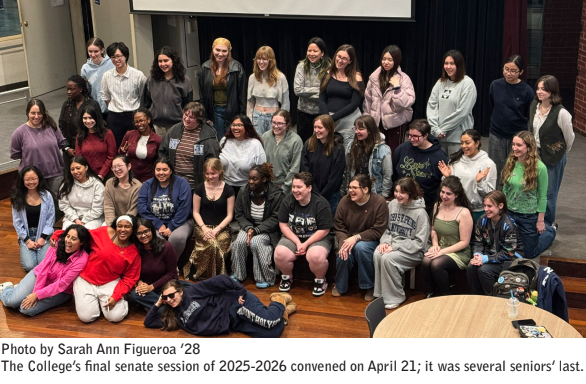
The final senate of the 2025-26 academic year, held on April 21, would be the last senate for many of the executive board members of the Student Government Association, including Senate Chair Coco Athas ’26.

Before the senators began the yearly budget vote, Athas gave her routine rundown of the weekly events, such as end of semester destressers and celebrations. With the change of seasons and upcoming festivities like Pangy Day, student organizations across campus are preparing their final gatherings of the year to give their communities the break they deserve. Once these brief announcements were made, Gabi Mello ’26 took the stage to go over the SGA’s budget.

The total collected from student activity fees this year was around $571,000. For the majority of the last senate, senators were given information about where these funds for the upcoming academic year would be going. A majority of the changes made to the budget for next year were increases in funding for various departments of the College. The Office of Residential Life and the SGA Ways and Means committee will both be receiving extra funds. For the cultural centers on campus, a $7,000 increase was allocated to keep them functioning and to support the events they hold throughout the year.

Chapin Auditorium is the hub for many of Mount Holyoke College’s annual events, both held by the College and by student organizations. The SGA has recognized this and will now be designating funding for events specifically held in Chapin, so all organizers may have the money they need. It is unclear yet how this money will be distributed evenly throughout the semesters.

Overall, the total for next year’s budget comes out to just around $702,000, almost $200,000 more than what was available from student activity fees.

The floor was then opened to a Q&A for senators to ask any questions they had about the new budget. One individual asked about the funding of an upcoming project for health and wellness vending machines around campus. SGA president Nathania Amadi ’26 provided a bit of insight, explaining that these vending machines will be stocked with a variety of hygiene products and over-the-counter medications which are not easily accessible on campus. SGA will be providing a portion of their funding to this project. Students can expect to hear more information about these vending machines in the 2026 Fall semester.

When it came time for the vote, Athas instructed the senators to raise their hands and say “aye” if they agreed to the proposed budget. The vote passed, and Athas took the stage again to conduct the remaining event announcements.

At the end of the senate, a small pinning ceremony was held for senators who would not be returning next year. A song akin to that which is played at an official commencement began, and each senator received a pin and gave an impromptu speech about their time being part of senate. Continuing with the humorous vibes, Athas gave a statement at the end of the ceremony, saying, “I just want to take a moment to thank everybody for their service … I know not everybody wanted to be here. I recognize that … Not all heroes wear capes.”

A group photo was taken with all of the senators and SGA executive board members, commemorating the final senate of the 2025-26 academic year. To the future executive board members in the room, Athas left them with a piece of advice that exemplified her time in the position of senate chair. “You are only as good as your best ice breaker.”

Abigail McKeon ’26 contributed fact-checking.

Asian, international students face hate: ‘I don’t feel safe’

By Quill Nishi-Leonard ’27

Editor-in-Chief

On March 11, 2026, Mount Holyoke College President Danielle Holley sent out an email to the Mount Holyoke student body announcing a tuition increase, which was “based on inflation as well as skyrocketing costs for health care, operations and utilities.” This change came following at least two other successive tuition raises — the College’s annual tuition in 2022-2023 was $58,280, over $10,000 less than 2026-2027’s $71,178 —  and instantly provoked student backlash across campus. 

While most criticism of the raise focused on the price increase itself, some students took to social media to direct their frustration at Asian and international students. Several anti-Asian and xenophobic comments were posted on Fizz, an anonymous social media platform for college students. Some posts read, “can the Asian internationals please let us know why they came all the way to America for an education?” and “you [international students] should’ve went to a more affordable institution … or better yet... maybe one in your home country.”

Dean Marcella Runell responded to the comments in her March 13 Dean’s Corner, stating, “The anti-Asian and xenophobic sentiments appearing on anonymous platforms like Fizz in response to the tuition letter are causing significant harm. I am hearing directly from your peers that they feel targeted and unwelcome in the very community that is meant to have their back.”

“This most recent behavior is not who we want to be. It stands in direct opposition to the care we owe one another and is fundamentally at odds with the Mount Holyoke Honor Code and our commitment to an inclusive environment,” Runell wrote.

Fizz: An ongoing issue

However, the comments posted to Fizz following the tuition raise were not the first of their kind that Asian American and international Mount Holyoke students have experienced in the 2025-26 school year. 

Just a few days prior, an anonymous account on Fizz had posted, “Just saw 3 Asian international students eat [at] blanch, get up, and leave their food/plates once they were finished. You know who you are...” 

According to several witnesses present at the scene, the students targeted by the post had only left the table to get ice cream. Many Asian American and Asian international students were hurt by the post and the sentiments it expressed. 

Liz Li ’28 and JJ Guo ’29 wrote about the post to the President’s Office in a March 12 email, saying, “Regardless of the underlying circumstances, the deliberate and unnecessary identification of ‘Asian international students’ in this public accusation is harmful, discriminatory, and reflects a pattern of targeting individuals based on their ethnicity and perceived national origin.”

“The phrase ‘You know who you are’ further lends a threatening and intimidatory tone to the post,” Li and Guo stated.

According to an international first-year student, who has asked to be referred to as Alex for this article, the President’s Office didn’t respond to the email for almost a month. “It took approximately three weeks for the administration to issue a response, and when it came, it felt delayed, generic, and disconnected from the urgency of the situation,” Alex wrote in an email to Mount Holyoke News.

Several hateful posts also circulated on Fizz during the fall semester, after a paper outside of Ham and MacGregor halls was discovered with the words “ching... and so” written on it. 

One anonymous post made shortly after the discovery stated, “What am I missing here? The word ‘ching’ is not racist.” Another read, “hot take some of y’all are begging to be discriminated against like the sign thing.”

Prejudice on campus

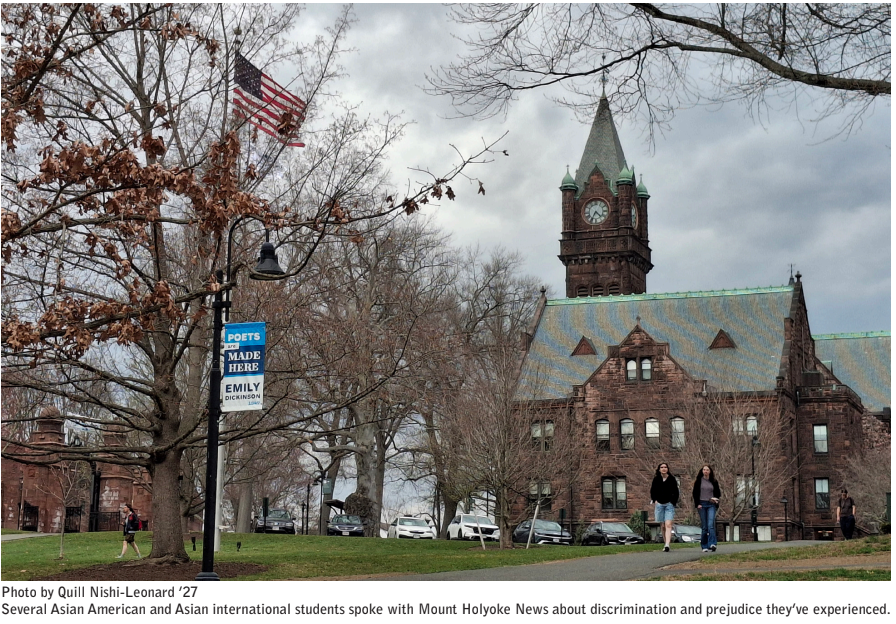
For many Asian American and Asian international students, these posts are the direct result of a hostile campus environment. Mount Holyoke News spoke with several to gather their perspectives on the situation.

Angela Kim ’28 stated, “I personally feel that these online incidents are reflective of the campus climate as a whole. The anonymity of Fizz and distance from the institution allow people to get away with hateful sentiments.” 

“Since the institution has made it clear that they can’t get involved in the moderation process, the true solution is to fix campus climate and educate students. This means that not only will students not publicly express these sentiments, but also feel them in the first place,” Kim said.

Liz Li ’28 shared a similar sentiment during an interview when discussing some of the Fizz posts from fall 2025: “I think that's the first time I realized … how widely the anti-Asian [hate] is on campus.”

Alex had parallel experiences outside of social media. “I have experienced clear microaggressions in academic settings. In my first-year seminar, when my fellow international students and I contributed to discussions, the professor would repeatedly say he needed to ‘translate’ our sentences for domestic students, even though we were speaking clear and simple English,” they wrote.

“More broadly, my experience does not align with the College’s portrayal of a ‘close-knit’ and supportive campus environment,” Alex stated.

Microaggressions are reportedly not an uncommon experience on Mount Holyoke’s campus for those of marginalized identities. In an email to Mount Holyoke News, Susan Jiang ’28 stated, “Something else that really left an indelible mark on me is that last semester we did a microaggression survey on campus, and found out that microaggression, heartbreakingly, exists in the living experience of many around us.”

Some students found the College’s response to the ongoing issue of anti-Asian hate and xenophobia on campus and online to be at odds with its commitment to diversity and inclusion.

“The College administration has had mixed responses to these incidents, but overall, I do not feel sufficiently supported by the College,” Kim stated. “Oftentimes … they don’t provide systemic or upstream solutions, so similar incidents can continue to occur.”

“I do not believe the College’s response has been adequate or proportionate to the seriousness of these incidents,” Alex wrote. “When harmful behavior is not addressed promptly and clearly, it sends the message that anti-Asian and anti-international student hate is, in practice, tolerated on this campus.”

“It’s taken forever to send out a statement, to send out an announcement, and we have to keep asking them to do that,” Li said. “They’re just saying, like, ‘International students or Asian students are important to us’ and … there’s a resource, like counseling … but those things … they are helpful, but they are not at the institutional level.”

Mount Holyoke News reached out to Christian Feuerstein, the College’s director of public affairs and media relations, and received a statement from the College: “Mount Holyoke College is committed to ensuring that every student is supported and respected. This emphatically includes Asian American, Asian international and all international students. We affirm that everyone on our campus deserves to be safe, to feel at home and to know that they belong.”

The statement continued, “We are also currently in an active dialogue about campus culture on anonymous apps like Fizz. Students have petitioned to have our Honor Code, which is the backbone of our community, explicitly applied to how we treat one another in digital spaces. The administration is working with student groups to find ways to maintain the safety of our community in these anonymous environments. When we are made aware of something potentially harmful or threatening we have asked Fizz to remove the post. However, they are an independent entity which functions as a for-profit business, and we are typically not successful as they are not obligated to cooperate with us.”
It’s unclear which students and student groups the College is in dialogue with, and what those discussions look like.

A lack of clarity surrounding students' rights — especially those of international students — and what students can do if they’ve experienced prejudice or discrimination on campus was also a common subject during interviews.

 Li stated that an overhaul of the anti-discrimination training new students receive would be helpful: “[Students] don't really know [their rights] until I tell them … but they also have lots of concerns,” Li said. “Like, for example, if they feel microaggression from their professor who they're taking class with, and if they report it, what's going to happen? Will that impact their grade or something?”

Training should also include clearer guidance about “what kind of thing will be regarded as microaggression,” Li said. “And if that happened, what do you do?”

Activists called into disciplinary meetings

Li, Alex, and Kim all stated that several students have been called into disciplinary meetings by Residential life for actions they undertook to raise awareness about issues Asian American and Asian international students have been experiencing at the College.

“I know three students who have been called in for disciplinary meetings. But just for really small things, like [writing in] chalk, put a poster on a table, or just try to post something, like a meme, on a padlet,” Li explained.

“This hasn’t happened to me, but it has happened to multiple students that I know,” Kim shared. “These meetings are systematically broken.”

Alex spoke about one specific incident: “A friend of mine was called into a disciplinary meeting after posting a ‘run away’ meme that had not even been approved on the Experience MHC padlet. Despite this, she received a formal notice in 24 hours stating that her behavior had ‘seriously disrupted other students’ educational experience,’ which is hard to understand given that the content was never seen by others.”

The Experience MHC padlet was a platform where current Mount Holyoke students were encouraged by the College to “share a kind word, message of welcome or any advice that they think would be beneficial” for admitted students. There was no clear prohibition against sharing memes or anecdotes critical of the College, but at least one student was called into a disciplinary meeting for submitting a picture that could have been perceived as negative. 

The meeting took place in a Reslife office from roughly 11:30 a.m.-1 p.m., during which around a dozen Mount Holyoke students sat outside in the hallway in support of the student who had been called in. A reporter from Mount Holyoke News was also present in the hall for the duration. 

Several students who attended expressed frustration about the process in which disciplinary meetings were called. Students who are called into disciplinary meetings by Reslife are not informed why they have been summoned until the meeting itself. Many reported feeling confused and anxious.

“Beginning at the initial letter that is sent out, there is a lack of clarity of what the meeting entails, which does not allow the student to adequately prepare. The letter also doesn’t specify that the student is allowed to bring a support person into the meeting,” Kim stated.

Students interviewed by Mount Holyoke News also expressed feeling a sense of confusion during such disciplinary meetings. 

“During the meeting, a Community Standards staff member, Nashalie, was unable to provide a clear or consistent explanation of the relevant student handbook policies, which raised concerns about how these guidelines are interpreted and enforced. The contrast is striking: the administration demonstrated the ability to act within 24 hours when disciplining a student, yet did not demonstrate the same urgency in responding to incidents of discrimination," Alex said.

“[Reslife] should stop scaring their students that way because the school claims that those kinds of meetings are offering support … but that’s not real,” Li stated. “The way they call students to there, and how they talk to students, will definitely not make students feel supported.” 

According to the College’s website and the statement from the College, the process is supposed to be restorative. “Disciplinary meetings are meant to be educational in nature and are designed to maintain communal boundaries,” the College wrote. “If anyone has any feedback on student conduct at Mount Holyoke it can be shared at dean-students@mtholyoke.edu.”

Despite this, many Asian American and Asian international students present in the hall during the meeting discussed feeling targeted and intimidated.

“I don’t feel safe because I just can see my friends, my fellow students are … called in for disciplinary meetings and since we’re international students, we hold the visas, and the visas depend on the school, and our financial aid also depends on the school,” Li explained during the interview. “So sometimes I will hear my fellow students try to remind me, [to] be careful because you need the school to keep your visa.”

“What happens in the meeting also causes a lot of damage,” Kim stated.

Students seek support, solidarity

Anti-Asian and xenophobic comments made by fellow students, alongside actions undertaken — or not undertaken — by the College have profoundly impacted all of the students who spoke to Mount Holyoke News. Facing a lack of support from the College, many have turned to one another for community.

“These experiences have had a tangible impact on my mental health. I have felt persistent stress, frustration, and emotional exhaustion. I have also seen peers experience significant distress, including emotional crises. Some have even had to take medical leave as a result. These are not isolated or abstract impacts — they are real and ongoing for both myself and other students,” Alex wrote.

“What I’m feeling right now is, I don’t have my life,” Li stated. “I don’t have time to talk to my family, because they ask, ‘Oh, how’s school going? And what fun things are you doing?’ And I cannot tell them, ‘Oh, I’ve been discriminated against.’”

“A campus cannot claim to be inclusive while failing to respond meaningfully and promptly to targeted hate,” Alex stated. “Students deserve more [from administration] than statements that are delayed, superficial, or disconnected from reality … we deserve to feel protected, heard, and valued.”

“We have the responsibility — and everyone has that — to stop [hate], and to do something, ” Li explained. “Right now, for example, Trump … wants to create hate … if we are isolated, or if we are even [fighting] against each other … they will be happy.”

“Over the past few months, the things my peers have done to address the racist incidents happening on our campus have given me lots of encouragement,” Jiang wrote to Mount Holyoke News. “It has been a great fortune for me to meet these wonderful, brave people.”

Kim also stressed the importance of community and friendships in advocacy: “The mental toll of seeing the harm is also taxing, but despite that, I still wouldn’t choose to be anywhere else. I am so grateful for my support systems and community.”

“Having those relationships is essential to organizing and not getting burnt out,” Kim stated.

“It’s really important for us to build solidarity inside Mount Holyoke,” Li concluded. “We should work together.”

Abigail McKeon ’26 and Madeleine Diesl ’28 contributed fact-checking.

Fizz, Native Spirit and upcoming heritage events discussed at Senate

By Genevieve Zahner ’26

News editor

Natasha Rios ’27 opened senate with a land acknowledgement, a moment of reflection, and an ice breaker for those attending before getting into the evening’s agenda.

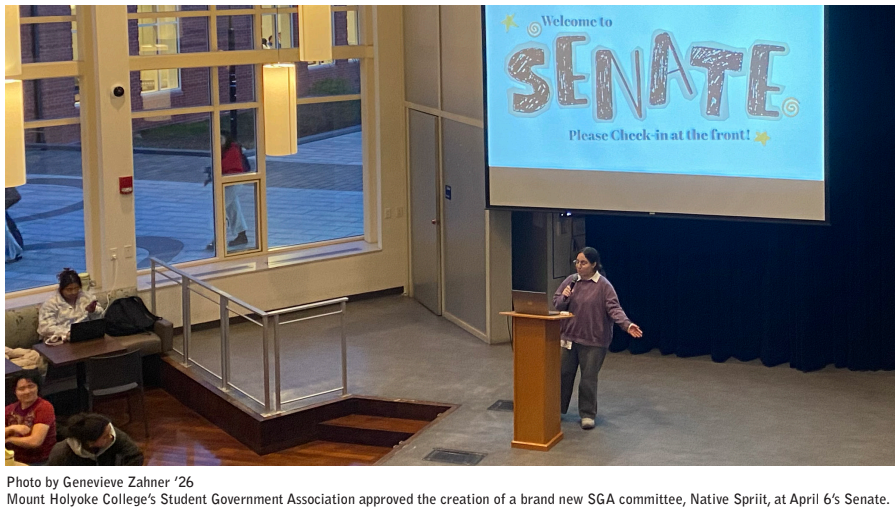
There was a presentation about a new SGA committee awaiting senate approval, called Native Spirit. The organization’s mission statement is to uplift, acknowledge and support Native and Indigenous students on campus, and to leave an “everlasting legacy of Indigenous led support for students.”

The committee aims to create a space for Native students in a “hegemonic environment” like Mount Holyoke College, and to hold the College accountable as an institution to “move beyond symbolic recognition” and provide sustained investment in the committee. Another goal of the committee is for Mount Holyoke to reconnect with the Native Nations whose land the institution occupies, and create lasting relationships with the nations to “preserve Native epistemologies at the college” as well as a stronger sense of belonging, cultural connection, and support for future Native leaders and trailblazers at the college. The senate then voted and approved the committee.

Those running for chair of senate and chair of halls positions made speeches for their candidacy. The senate will vote later this week. The senate’s prepared presentation closed with several event announcements before moving on to representatives for organizations’ announcements.

The events featured during these announcements were Women and the World of Work which featured alum Sarita Gupta ’96 on April 8, the opening ceremony for Asian, Asian American, Native Hawaiian and Pacific Islander heritage month on April 9, Korea night on April 10, Holi on April 12, Nauryz Festival Celebration on April 13 and Experience MHC for prospective students April 12-13.

The senate then opened up for questions, concerns and announcements from representatives, and began with concerns about the cleanliness of washing machines in Buckland and Abbey, for which facilities management was contacted.

The representative from Queer Action Collective advertised the Civil Disobedience Training on Saturday, April 11 from 11 a.m.-4 p.m. and Protest Marshall Training on Sunday, April 12th from 11 a.m.-1 p.m., both at the Jeannette Marks House.

Asian Students Association advertised the 5PAN conference hosted by the Five Colleges at Hampshire on April 19 from 9 a.m.-6 p.m. and the Nauryz festival, which is a Central Asian holiday celebrating the coming of spring, on April 13 from 6:30-7:30 p.m.

MHC Votes advertised their voting forum with South Hadley town officials from 2-4 p.m. on April 26, which will include opportunities to have one-on-one conversations with state officials Senator Oliveira and Representative Gomez about what to know for the upcoming local elections.

Several students then took the opportunity to speak about incidents on Fizz that have sparked conversations about the treatment of Asian students on campus, including Ivy Zhou ’27, Cindy Ntembe ’27 and Nathania Amadi ’26. The administration as well as President Holley have been contacted regarding the recent uptick in discriminatory posts on Fizz, the anonymous campus app, and on Sunday, April 12, a protest was held. More information about upcoming events and updates regarding anti-Asian hate on campus can be found on @stopasianhatemhc on instagram. The importance of supporting departments that can provide cultural education was noted by Ntembe, along with engaging with local communities and voting in both campus and governmental elections in order for students to educate themselves. Amadi additionally spoke on the importance of students taking accountability for their actions, noting that change has to come from within, saying “when harm is being perpetuated in the community it's our responsibility to curb that hate” especially regarding recent discriminatory Fizz posts that were made against international and Asian students.

Amadi also stated, “People need to unlearn hate and bigotry, do work and educate yourself,” especially regarding the treatment of international and Asian students. She noted the importance of the collective, saying students “need to come together or the change won’t be made” and that students should hold themself accountable in addition to the institution.

The next senate will be held on Tuesday, April 14 at 7:30 p.m. in the Blanchard Great Room.

Jillian Stammely ’28 contributed fact-checking.
Dining Services reports $30,000 worth of missing dishes since Fall ’25

By Paige Comeau ’26

Managing Editor of Content

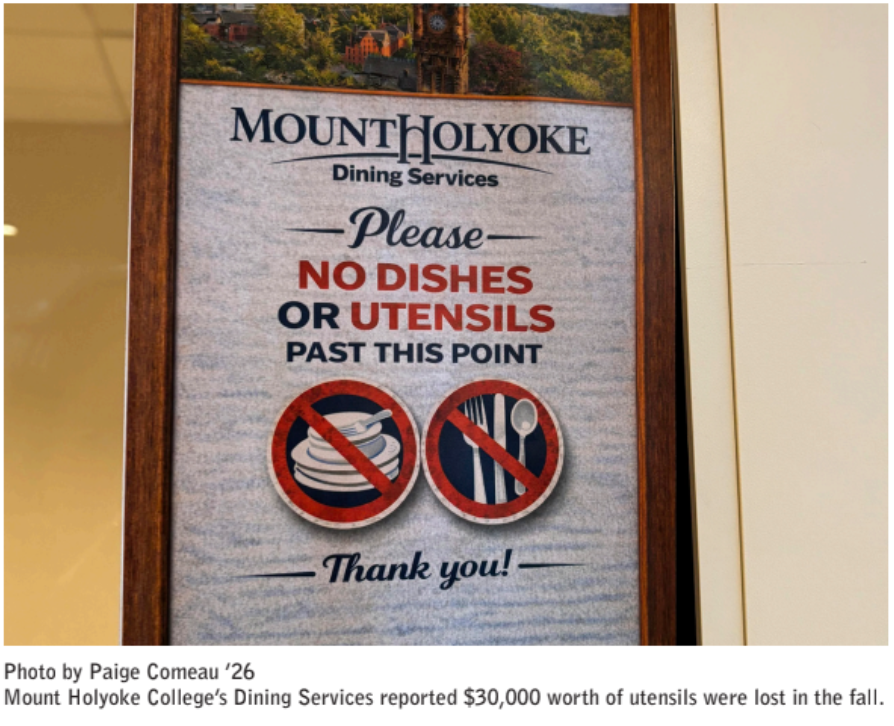
Beginning the week of April 6, 2026, students were greeted by two large signs on the glass doors of the Dining Commons. One sign promotes USEFULL, Mount Holyoke College’s reusable tupperware program, while the other, lettered in a bold red, reads: “Please, no dishes and silverware beyond this point.”

These signs appeared following an email from Dining Services, sent on April 1, titled “Help Us Keep Your Dining Experience Top-Tier: A Reminder on DC Policy.” In this message, Dining Services offered students the reminder that in order “to keep our operations sustainable and our tables fully stocked, we need to ensure that our china, glassware and silverware stay where they belong: right here in the Dining Commons.”

To emphasize the importance of this message, they added that since the fall semester, they have lost almost $30,000 worth of dishes and utensils, or around 3,318 pieces of silverware, 900 large dinner plates, and hundreds of soup cups and bowls. The money they spend replacing these items, constitutes a significant portion of their budget, which they would much rather spend on other things.

In response to this email, many students noted disbelief. “I don’t believe that the couple of borrowed plates and silverware here and there amounts to 30,000 dollars,” Emily Steadman ’26 said in a written statement to MHN.

Similarly, Callie Lantz ’26 stated, “I would like the budget to go to the nice forks if we're going to be spending a lot and [being] hyper vigilant about our silverware.”

Nevertheless, Dining Services has added new procedures to the Dining Commons in order to enforce the seriousness of the issue. Alongside the signs, dining staff will now be more proactive with asking students to finish their food in the Dining Commons, or to use a USEFULL Container. Further, Dining Services will be implementing a No-Questions-Asked return policy around dishware, asking students to drop off any taken dishware on the Dining Commons carousel anytime, with no questions asked.

“We aren’t looking to assign blame,” the email states. “We just want our dishes back so we can keep serving you effectively.”

Jillian Stammely ’28 contributed fact-checking.

Dining unveils various new programs at March town hall

Photo by Emma Quirk ’26

Dining went over many new programs with Senators on March 10, 2026 during a town hall, answering questions about food preparation and disposal.

BY SARAH ANN FIGUEROA ’28

STAFF WRITER

The SGA Senate town hall on March 10 hosted three senior members of the dining staff at Mount Holyoke, who shared exciting new additions coming to the Mount Holyoke dining experience. 

Adorning their signature white chef jackets embroidered with the College’s logo, Shawn Kelsey, associate director of culinary operations, Peter Haas, director of dining services, and Dino Giordano, campus executive chef, all attended Senate for the monthly town hall meeting.

Beginning with what has already been implemented, Kelsey announced the creation of the Dining Ambassador Program. Inspired by the language tables that used to exist in individual dining halls before the creation of centralized dining in 2018, the purpose of this program is to bring meaningful, authentic meals to dining. The dining ambassadors are current students of Mount Holyoke College who represent the diverse communities that exist on campus. They are meant to be accessible for every student to voice their concerns and feedback for dining.

Through these ambassadors, dining staff will learn more about how the dining program can be improved to better serve the needs of our campus. Note that this is not a replacement for preexisting ways of communicating with dining. The QR codes posted around Blanchard Hall are still valid, as well as the MHC dining email, dining@mtholyoke.edu.

Kelsey addressed that everyone at dining really appreciates the positive feedback they receive from the community. “It does genuinely mean a lot to us,” he said. He further added that any high praise given gets printed out and posted around the different stations in the dining hall for staff to see, creating a motivating and encouraging environment.

One of the first dining ambassadors is Cedar Xiao ’29. In an interview with Mount Holyoke News about her perspective on the new program, Xiao said “I feel like I'm really contributing to my community.” Another major component of the dining ambassador role is to provide dining with new recipe suggestions, and Xiao shared how her experience with that aspect of the role has been. She had received feedback from many of her fellow Chinese international students that the meals served at the Wok station are too sweet compared to how they are traditionally made. The fix to this problem isn’t as simple as adding less sugar, as all recipes served in dining are prepared months in advance, and chefs must follow them to the ounce. 

“What I got to do was I found recipes online for other universities in China, and I translated that into English,” Xiao said. “We just did a taste testing yesterday afternoon for more authentic Chinese recipes.” Having invited her friends to provide feedback, many approved of the new recipe.

Hopefully, students can anticipate the quality and authenticity of dishes served in dining to increase with this program. Recounting this taste testing session during the town hall, Giordano noted, “When we get to sit down and eat a meal together, it’s a wonderful and meaningful thing.” If anyone would like to join the dining ambassador program, they should reach out to Shawn Kelsey at kelsey@mtholyoke.edu.

Anyone who has been in the dining hall this semester will have noticed the new dish drop, which was changed over the 2025-26 winter break. Dining shared that the new dish return system is a major improvement for those on the other side of it. 

“It's really helping out the dish room staff,” Haas said. “They are smiling, and the floors are clean, and they're not getting piles of dishes.” It was noted that there are a few technical components in the back of the house that are not yet operational, which may explain why there has been a buildup of dishes during the popular meal time rushes.

One student during the town hall brought up how many students with mobility aids have expressed that the new dish return system is not accessible to them. Kelsey said that the new dish drop is compliant to the Americans with Disabilities Act, however, they are willing to talk with individuals facing challenges to see what they can do to improve the system. 

In terms of other back of house updates, the kitchen now features a new walk-in fridge. This allows for better, more sustainable food storage, and will open up more opportunities for different meals. The expansions to Blanchard Hall in 2018 were not designed with enough storage space for food. As a result, a large refrigerated truck has been parked in the back of the building on weekends to store dairy, produce, and other highly perishable items. With the new fridge, the truck will no longer be needed.

The last new addition to Dining Services is the Grab & Go donation system. Uneaten leftovers from the Grab & Go stations across campus are now being shared with the Food Recovery Network, and sent to Kate’s Kitchen in Holyoke to be distributed. As of March 10, 34 meals have been donated already. These leftovers will be picked up every Tuesday, Wednesday, Thursday, Friday, and Saturday.

Kelsey, Haas and Giordano also unveiled many things that are to come to Dining Services in the near future, the first being a collaboration with the Miller-Worley Center for the Environment. At the Frances Perk cafe, located in the Williston-Memorial library, students will soon be able to check out and return USEFULL cups. Any drink that is ordered with a USEFULL cup will come with a 15 cent discount.

Following spring break, raw fish will enter the sushi program once a week. The first raw fish included will be Ahi Tuna. The program will start slowly and gradually be built upon. Ahi Tuna will be included in premade poke bowls on Tuesdays and premade sushi rolls on Wednesdays, alternating every other week, to be served at both the Sushi station and the Grab & Go stations. 

Another announcement that had many Senators excited was the new smoothie bar to come to the Cochary Pub & Kitchen. The bar will replace the espresso machine, and operate in the same fashion as everything else in the Pub does. Smoothies will be available for purchase via cash, credit or dining dollars. It will be a build your own style experience, with a wide variety of fresh fruit, vegetables, yogurts, smoothie bases and other toppings to choose from. 

Finally, a small yet significant piece of news to come out of this town hall is that food waste across campus is reducing overall, and Dining Services will be doing what they can to continue this trend. It was disclosed that they use an AI program centered around food waste management solutions known as Leanpath to track post consumer food waste leaving our college, and will be taking the usage of it a step further. 

With the Leanpath Spark Program, all of the food coming off of students' plates will be weighed in real time, as workers in the dish room dump all uneaten food into a bin atop a scale. A screen that will be installed in the dish drop area will display and live update the scale’s measurements. Leanpath’s AI will compare the numbers with important metrics, such as how many people could have been fed with the food that has been wasted.

Though there may be something contradictory about using artificial intelligence, a known energy waster and massive consumer of resources, to track food waste in our college, dining made an effort to focus on the positive aspects of this program. 

“It's the right thing to do,” Kelsey stated. “That's why our mission is to reduce that food waste. Not because it's going to save the college money, but because it's the right thing to do. It's something that we can do as a community to help with the global warming issue that we're dealing with.” 

Quill Nishi-Leonard ’27 contributed fact-checking.

Mount Holyoke's production of Melancholy Play runs for three performances

Graphic by Quill Nishi-Leonard ’27 via Canva

BY GENEVIEVE ZAHNER ’26

NEWS EDITOR

The Mount Holyoke film, media and theater department opened their production of Melancholy Play on Thursday, March 5. The play, written in 2002 by Sarah Ruhl, follows the main character, Tilly who “is a bank teller with a melancholy so exquisite it becomes magnetic: everyone she meets falls hopelessly in love. But when Tilly suddenly discovers happiness, her joy unbalances the delicate orbit she’s drawn around her admirers,” according to an email from the film, media and theater department. The play is described as exploring “what it means to live inside intense feeling: the seductive power of sorrow, the disquiet of joy, and the strange, shifting desires that bind us to each other,” the department stated.

This play also served as the directorial debut of Emma Platt ’26, and was the first show that she has solo directed at the College. Though Platt directed Eurydice, another Sarah Ruhl play, in her high school career, this was “a huge and rewarding undertaking” as it had the “most moving parts and largest team” she’d ever worked with. Her Mount Holyoke career thus far has been directing short scenes for class and plays for the 2024 and 2025 short play festivals, and said “A full-length mainstage show of which I am the only director was daunting and a lot of work, but also my most rewarding experience at Mount Holyoke” of her experience with Melancholy Play. 

The play was chosen by the film, media and theater department in fall 2024, and since the play features a live cellist, this part was cast around this time as well. However, production meetings with stage management and design teams began in fall 2025, with auditions and casting happening towards the end of the Fall 2025 semester. 

The entire cast and crew came to campus a week early from winter break to begin rehearsals, including table work, blocking and music learning. “The whole thing has come together in a truly fantastic way, and I couldn't be prouder of the cast, crew, and designers for the incredible work they did,” Platt said. She also expressed her love for directing and the process of working on a play. 

“Working with such wonderful artists and collaborating to make something bigger than all of us, and seeing it come to life, is so rewarding. I have always loved bringing ideas to life and creative collaboration, and directing is the perfect intersection between those things,” Platt stated. 

Kainoa ChesemoreWalling ’27 was the stage manager for the production, and said of the experience, “Last year I got to work as an [assistant stage manager] on Marie Antoinette which was super fun and I was excited to work on another student directed show here. … We also brought in a lot of supporting artists to help us with the production like Jay Doane, our student fight choreographer, and then a dialect coach and intimacy coordinator, which was super fun to collaborate with all of these artists.” 

They spoke more on the process of tech rehearsals, and how that differed from the five weeks of rehearsals they had before starting tech, “At this point I was fine tuning transitions and props shifts so that once we were in tech everything would go as smoothly as possible. In tech we did two days of cue to cue because we had a more tech heavy show. Then by that point we were able to do a full run through some trouble points and then we had three dress rehearsals before we had an audience!” 

ChesemoreWalling said her favorite part of stage managing is seeing everything come together, and that “For the most part everyone works on the production separately until tech. The actors are in rehearsal during the evening and the production teams are working on getting the designs created. As the SM I am one of the people who form a bridge between the two, making sure things are communicated and aligning with the collective vision of the show. Once we hit tech it is magical to see everyone's hard work get pieced together.” They also enjoyed connecting with everyone working on the show, and having “silly and fun moments” together. 

Platt also spoke on the importance and her appreciation for the rest of the cast and crew, saying, “I want to express my endless appreciation, respect, and love for the incredible cast, crew, and design team. This would have been impossible without them. I want to especially emphasize the importance of Kainoa, Juno and Sabine, our stage manager and assistant stage managers. They kept this whole thing running in a way I never could alone. Also, thank you to Michael Ofori for being an incredible faculty advisor for the project.” 

Melancholy Play ran from March 5-8 in Rooke Theatre, and will be followed by the spring production of POTUS in April. Alayna Khan ’28 contributed fact-checking.
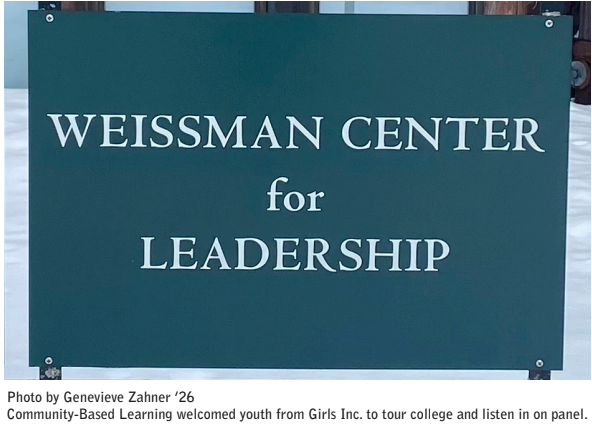
CBL welcomes youth from Girls Inc. to visit campus and meet students

By Emma Quirk ’26 & Genevieve Zahner ’26

News & Photos Editor | News Editor

Mount Holyoke Community-Based Learning welcomed Girls Inc. of Holyoke, Massachusetts to campus on Wednesday, Feb. 18 for a visit and panel discussion about college and the opportunities that Mount Holyoke has to offer. 

Girls Inc. works with various partners to “ensure that all girls have what they need to thrive — in school, at home, and in their communities” by providing elementary, middle and high school programs to provide academic support, personal development, career exploration, and bolster physical well-being. They additionally have a program called Eureka!, where girls participate in a five year program from 8th grade through their senior year of high school working with professors at the University of Massachusetts in classrooms, labs and in the field of different professions to boost college and career preparation, building skills and confidence both academically and personally. 

A cohort of girls from Girls Inc. visited campus, taking a tour of the equestrian center andthe greenhouse, before concluding the tour at the Betty Shabazz Cultural Center. There, they had lunch and reflected on what they learned and thought about any questions they might have had. 

The middle and high school students then sat in on a panel discussion with current Mount Holyoke students where they were able to ask questions about the college process, Mount Holyoke and what opportunities are available to them both at Mount Holyoke and at other members of theFive Colleges. The elementary school children sat in on a separate listening circle, where they were able to have a similar conversation, more tailored towards providing early exposure to the college environment for young learners. Trinity Moore ’29 is a CBL Fellow and is partnered with Girls Inc. as an after-school intern. She was part of organizing and running this visit and was pleased with its outcome. “The visit went really smoothly!” she said in an email interview with Mount Holyoke News. “My main concern was that the visit be age-appropriate and interesting to the range of students we would have visiting (5-13-year-olds). Thankfully, we did things that intrigued all ages, like visiting the Equestrian Center and the greenhouse, and offering coloring pages for students during a Mount Holyoke student-unofficial panel.” 

Additionally, she was grateful for the diversity of students part of the panel discussion.  “This kind of visibility is crucial for prospective students, as it allows them to see themselves reflected in the current student body, reinforcing the conviction that they are incredibly capable of succeeding in college,” Moore said. 

Akilah Williams ’26 was another of the student leaders who was part of this collaboration between CBL and Girls Inc. “Leading a segment during the visit was especially powerful for me as it made me feel trusted by CBL and affirmed that they genuinely value us tutors as individuals and leaders,” Williams said. “That trust meant a lot to me as it showed me that my voice matters not just in theory, but in practice.”

Williams found the visit to be particularly meaningful because she had been part of Girls Inc. herself as a middle schooler in New York. “Being able to now give back to a program that once poured into me felt full circle. It reminded me how impactful and empowering Girls Inc. truly is,” she said. “Seeing the girls engage with our campus and ask questions reinforced how important spaces like this are for young people. I’m also really grateful that CBL collaborated with Girls Inc. and gave us, as students, the opportunity to share our experiences about campus life.” 

Reflecting beyond this event, working with CBL has pushed her to be more involved in and take action in the local Western Mass. community. “For me, CBL means refusing to turn my back when I see injustice, discrimination, or inequality,” Williams said. “Community-based learning gives me the tools and the space to respond rather than remain silent. Through CBL, I’ve learned that real change starts with presence. Showing up matters. Listening matters. Advocating matters.” 

Cat McKenna ’28 contributed fact-checking.